

An ACL injury changes things fast.
One moment you’re cutting, pivoting, landing, accelerating.
The next, everything slows down.
There’s swelling.
Instability.
Uncertainty.
And then the bigger question shows up:
“What now?”
If you’ve torn your ACL — whether recently or months ago — here’s what you need to understand:
ACL recovery is not just about the ligament.
It’s about strength.
It’s about structure.
It’s about restoring trust in your body.
Let’s break this down clearly.
What the ACL Actually Does

The ACL (anterior cruciate ligament) stabilizes the knee, especially during:
- Cutting
- Pivoting
- Sudden deceleration
- Direction changes
- Landing from jumps
It prevents excessive forward movement of the tibia relative to the femur and contributes to rotational stability.
When it tears, the knee can feel unstable — particularly during dynamic movement.
But here’s the key point:
The ACL is passive tissue.
Your muscles are active stabilizers.
And recovery depends heavily on them.
Surgery or No Surgery?
Not every ACL tear automatically requires reconstruction.
Some individuals opt for structured rehabilitation alone. Others choose surgical repair, particularly if returning to high-demand pivoting sports.
Regardless of the path:
Rehab is non-negotiable.
Surgery does not restore strength.
It does not restore coordination.
It does not restore movement confidence.
Rehabilitation does.
Phase 1: Calm the Knee Down

Early ACL recovery focuses on:
- Reducing swelling
- Restoring knee extension
- Regaining basic quad activation
- Normalizing walking
The quadriceps often shut down after ACL injury. That inhibition must be addressed early.
Key priorities:
- Full knee extension
- Controlled flexion
- Quad sets
- Straight leg raises
- Heel slides
This stage isn’t flashy. But it sets the foundation.
If full extension isn’t restored early, long-term mechanics suffer.
Phase 2: Build Foundational Strength

Once swelling is controlled and basic motion returns, strength becomes the focus.
This is where many people underestimate the work required.
ACL rehab is not light band exercises forever.
We progressively load:
- Quadriceps
- Hamstrings
- Glutes
- Calves
Exercises may include:
- Squats
- Step-ups
- Split squats
- Leg press
- Hip hinges
- Glute bridges
Strength deficits are common even 6–12 months post-injury.
Symmetry matters.
Strength must be measurable — not assumed.
The Quad Is King
The quadriceps muscle plays a critical role in knee stability.
After ACL injury or surgery, quad strength can drop significantly.
If quad strength isn’t rebuilt:
- Jumping power suffers
- Landing control decreases
- Re-injury risk increases
We don’t just “wake up” the quad.
We overload it progressively.
Heavy, controlled strength work becomes essential as rehab advances.
Avoiding load out of fear delays recovery.
Phase 3: Reintroduce Dynamic Movement
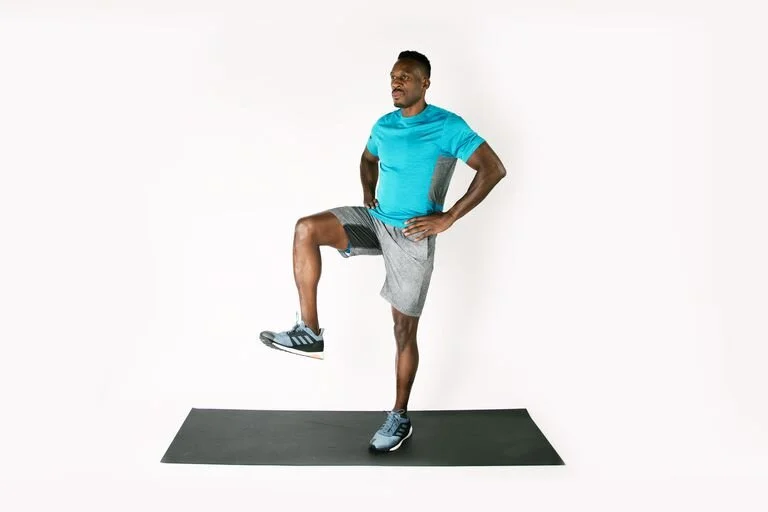
Strength alone isn’t enough.
ACL injuries often occur during unpredictable, high-speed movements.
Rehab must eventually include:
- Single-leg stability
- Lateral movement
- Acceleration and deceleration
- Jumping and landing mechanics
- Change of direction drills
This is where confidence often lags behind physical capacity.
Controlled exposure reduces fear.
We progress from:
Stable → Controlled dynamic → Reactive → Sport-specific
Skipping steps increases risk.
Return to Running
Running typically re-enters the program once:
- Strength benchmarks are met
- Swelling is minimal
- Landing mechanics are controlled
Return-to-run programs are gradual.
Walk-jog intervals.
Volume monitoring.
Surface selection matters.
Rushing this stage is one of the most common mistakes.
Capacity first. Speed later.
Psychological Recovery Is Real

ACL recovery isn’t just physical.
There’s hesitation.
Fear of re-tearing.
Fear of cutting hard.
Fear of landing aggressively.
If that fear isn’t addressed, performance drops — even if strength returns.
Confidence is rebuilt through:
- Objective strength testing
- Gradual exposure to sport movements
- Clear benchmarks
- Measurable progress
Trust isn’t forced.
It’s earned.
Common Mistakes in ACL Rehab
Let’s be direct.
- Stopping rehab too early.
Just because daily activities feel fine doesn’t mean sport readiness exists. - Avoiding heavy loading.
Under-loading leads to under-preparation. - Skipping single-leg work.
Most ACL injuries occur on one leg. - Ignoring hamstring strength.
Hamstrings help stabilize the tibia. - Returning to sport without testing.
Strength symmetry, hop testing, and force production matter.
ACL recovery isn’t about timelines alone.
It’s about readiness.
How Long Does ACL Recovery Take?
Timelines vary.
Post-surgical recovery often spans 9–12 months before full sport return.
But here’s the reality:
Biological healing and performance readiness are not the same thing.
You may be “cleared” at 6 months.
That doesn’t mean fully prepared.
Progress should be based on:
- Strength metrics
- Functional testing
- Movement quality
- Psychological readiness
Not just the calendar.
The Bigger Picture
An ACL injury feels like a setback.
But with structured rehab, it can become a rebuild.
You often return:
- Stronger
- More balanced
- More intentional
- More resilient
Because you’ve addressed weaknesses that may have existed pre-injury.
The key is doing it properly.
Not halfway.
Not rushed.
Not fear-driven.
What Recovery Should Feel Like
Challenging — but structured.
Progressive — not random.
Measured — not guessed.
You should know:
- Your quad strength ratio
- Your single-leg capacity
- Your hop test symmetry
- Your progression timeline
If rehab feels vague, it probably is.
Clarity builds confidence.
Final Thoughts
The ACL is one ligament.
But recovery is about the entire system.
Strength.
Coordination.
Load tolerance.
Confidence.
If those are rebuilt correctly, return to sport isn’t just possible — it’s sustainable.
The knee is capable.
It just needs structured preparation.
Ready to Take the Next Step?
If you’re recovering from an ACL injury — whether pre-surgery, post-surgery, or months into rehab — having a clear plan matters.
A free Discovery Visit is an opportunity to assess current strength, review movement capacity, and map out a progressive return-to-performance strategy.
Book a free DV today and start rebuilding strength, stability, and confidence the right way.